
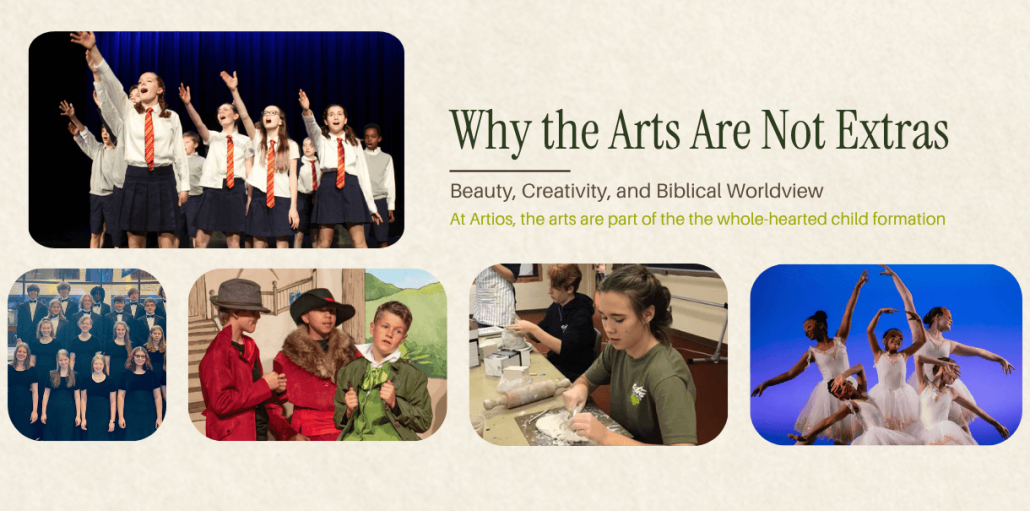
Why the Arts Are Not Extras: Beauty, Creativity, and Biblical Worldview
In many educational conversations, the arts are still treated as something added after the “real” work is done. They are often described as enrichment, electives, activities, or extras—good things, certainly, but not necessarily central things. When schedules grow full, when budgets tighten, or when academic pressure increases, music, visual art, theatre, dance, creative writing, and cultural study are often the first areas to be reduced or set aside.
At first glance, that may seem practical. Parents want their children to be prepared. They want them to read well, think clearly, communicate effectively, work diligently, and succeed in the areas that will matter for their future. Those desires are good and understandable. But if we begin with Scripture, we are invited to see preparation through a much larger lens. We are not raising children merely to complete academic requirements or achieve measurable outcomes. We are raising whole persons—children made in the image of a creative God, children whose hearts, imaginations, affections, tastes, discernment, and worldview are being shaped every day.
That is why, at Artios, the arts have never been treated as extras. They are not decorative additions to education. They are deeply connected to the formation of the whole-hearted child.
Creativity Begins with God
The Bible begins with a Creator. Before we are introduced to human activity, human work, human culture, or human learning, we are introduced to God as the One who speaks, forms, separates, fills, orders, names, and delights in what He has made. Creation itself reveals His beauty, order, variety, rhythm, structure, and abundance. The world God made is not merely functional; it is beautiful.
That matters for education.
If God had created a world that was only efficient, we might be able to justify an education concerned only with utility. But He did not. He made a world filled with color, sound, texture, pattern, movement, language, story, and song. The heavens declare His glory. The trees clap their hands. The tabernacle was filled with artistry. The Psalms call God’s people to sing, play instruments, remember, proclaim, and worship in the beauty of holiness.
Human creativity, then, is not an accidental feature of childhood or a pleasant diversion from serious learning. It is part of what it means to bear the image of God. Children create because they were made by a Creator. They imagine because they were designed with inner lives that respond to story, symbol, beauty, and meaning. They sing, draw, move, build, act, compose, and respond because they are not machines to be optimized, but persons to be formed.
This does not mean every child will become a professional artist, musician, actor, writer, or designer. That is not the point. The point is that every child is creative because every child is human. Creativity may show itself through music or theatre, but it may also show itself through problem-solving, leadership, hospitality, craftsmanship, entrepreneurship, scientific inquiry, teaching, design, or the ability to see connections others miss. To neglect creativity is not merely to neglect an activity. It is to neglect part of the child.
Beauty Forms the Heart
One of the reasons the arts matter so deeply is because beauty has a way of reaching places that information alone does not. A child may memorize a fact and forget it by Friday, but a hymn, a painting, a poem, a story, or a dramatic moment can remain lodged in the imagination for years. The arts have the ability to embody ideas, to give form to longing, to make visible what a culture loves, fears, worships, and believes.
This is why the arts are never neutral. They are always carrying meaning. Music can stir courage, grief, rebellion, worship, nostalgia, or desire. Literature can shape a child’s understanding of heroism, suffering, justice, identity, and redemption. Visual art can train the eye either toward reverence or distortion. Theatre can help students inhabit a story, consider another perspective, and understand the moral weight of human choices.
At Artios, we have often said that without a biblical worldview of the arts, the arts become distorted; but with a biblical worldview, the arts become a canvas through which students can see truth illustrated and the heart of man illuminated. This is not simply about protecting children from negative influences, though discernment is certainly necessary. It is about helping them understand the world they already inhabit. Whether or not we formally include the arts in education, children are surrounded by music, images, stories, performances, design, media, and messages every day.
The question is not whether the arts will shape them. The question is whether they will be taught to view the arts wisely, biblically, and redemptively.
The Arts and Worldview
Worldview is not formed only through lectures or textbooks. It is often formed through imagination. Children absorb ideas through the songs they sing, the stories they love, the heroes they admire, the images they see, and the emotional patterns they return to again and again. Long before a child can articulate a philosophy of life, he or she is already developing a sense of what is beautiful, what is admirable, what is normal, what is worth pursuing, and what kind of story they believe they are living in.
This is why cultural literacy matters. A student who studies history without the arts misses one of the primary ways people have expressed the ideas, conflicts, longings, and beliefs of their time. Art, music, theatre, literature, and architecture do not develop in isolation. They are shaped by history, and they also shape history. They reveal what a people worship, what they fear, what they celebrate, and what they assume to be true.
A biblical education should therefore do more than expose students to the arts. It should teach them to discern. Students need to learn how to ask: What view of God is implied here? What view of man? What is being celebrated? What is being diminished? What does this work suggest about truth, goodness, beauty, suffering, freedom, identity, or redemption? Where does this reflect God’s design, and where does it distort it?
This kind of engagement is not fear-based. It is wisdom-based. We want students to become culturally literate without becoming culturally captive. Like Paul in Athens, they need to understand the world around them well enough to speak with clarity, compassion, and discernment, while remaining anchored in the truth of God’s Word.
What Research Helps Us See
While our first reason for valuing the arts is biblical, it is encouraging to see how research continues to affirm that the arts contribute meaningfully to a child’s development. The arts are not valuable merely because they may support academic growth; they are valuable because they are part of a full and humane education. Still, the research reminds us that when the arts are removed from education, children often lose more than an activity.
A 2025 National Endowment for the Arts report, Snapshots of Arts Education in Childhood and Adolescence, analyzed three longitudinal datasets from the U.S. Department of Education’s National Center for Education Statistics. The report found that children’s arts participation was positively related to social-emotional attributes and academic outcomes. In early childhood, consistent engagement in arts activities at home—such as singing, reading, storytelling, and creative play—continued to predict academic outcomes in reading, math, and language even after accounting for demographic and family characteristics.
That is significant because it reminds us that arts involvement is not limited to performance or formal lessons. In the earliest years, the arts often appear through ordinary family life: songs sung over a child, stories read aloud, blocks stacked and rebuilt, pictures drawn, rhymes repeated, and imagination awakened. These simple practices help form language, attention, memory, connection, and joy.
Other research has examined arts participation within school settings. A large-scale study of Houston’s Arts Access Initiative, discussed by Brookings, found that students who received a substantial increase in arts educational experiences saw measurable academic, social, and emotional benefits. Compared with students in the control group, students in treatment schools experienced a 3.6 percentage point reduction in disciplinary infractions, improved standardized writing scores, and increased compassion for others. Among elementary students in particular, the study also found positive effects on school engagement and college aspirations.
For parents, these findings should not surprise us. The arts require attention, discipline, listening, collaboration, practice, revision, empathy, embodied participation, and perseverance. A student in theatre must consider motives, timing, language, and relationship. A student in music must learn order, pattern, practice, restraint, and expression. A student in visual art must observe carefully, make choices, revise, and attend to both detail and whole. These habits do not remain sealed off from the rest of life.
Achievement Is Not the Highest Aim, But It Still Matters
Some of the most frequently cited arts education research comes from the National Endowment for the Arts report The Arts and Achievement in At-Risk Youth, which examined four large longitudinal datasets. The report is careful to note that many of its findings show correlation rather than simple cause and effect. That distinction matters, and we should speak honestly about it. But the patterns are still worth noticing.
Among students from low socioeconomic backgrounds, those with high levels of arts involvement showed stronger outcomes in several areas. In one dataset, 71 percent of low-income students with arts-rich experiences attended some form of college after high school, compared with 48 percent of their low-arts peers. Thirty-nine percent attended a four-year college, compared with 17 percent of low-arts students. In another comparison, high school students who earned few or no arts credits were five times more likely not to graduate than students who earned many arts credits; the report showed a 22 percent non-graduation rate among low-arts, low-income students, compared with 4 percent among high-arts, low-income students.
The same report found differences in academic and civic measures as well. Low-income eighth graders with high arts engagement showed higher average science and writing scores than peers with low arts engagement. Students with arts-rich experiences were more likely to aspire to college. Later, young adults with intensive arts experiences were more likely to vote, volunteer, and participate civically.
Again, the purpose of the arts is not merely to raise test scores or improve college attendance. If that becomes our only argument, we have already accepted too small a vision. But these findings do challenge the assumption that the arts are expendable. When children are given sustained opportunities to participate in the arts, something larger is often being cultivated: attention, confidence, perseverance, communication, collaboration, responsibility, and a sense that their gifts have a meaningful place in the world.
The Arts Help Children Know Themselves Rightly
One of the quieter gifts of the arts is that they often help children discover capacities they may not have recognized in themselves. Some children who struggle to shine in traditional academic settings begin to find their voice through music, theatre, drawing, movement, design, or storytelling. Others learn that excellence requires discipline, not just talent. Still others discover that their gifts are not meant for self-display, but for service.
This matters because a child’s sense of worth is easily distorted. A performance-driven culture teaches children to measure themselves by comparison, achievement, applause, or visibility. A biblical view of the person begins somewhere else. A child’s worth is not created by talent, performance, or recognition. It is rooted in the fact that he or she is made in the image of God.
The arts, rightly understood, can help reinforce this truth. They invite students to steward what God has placed within them. They teach that gifts must be developed, not merely possessed. They help students experience the difference between expression that draws attention to self and expression that offers something truthful, beautiful, excellent, and life-giving to others.
This is one reason the arts at Artios are connected to character and conscience. Practice requires self-government. Ensemble work requires humility. Theatre requires listening and presence. Visual art requires patience and attention. Music requires submitting to structure in order to create beauty. The arts continually remind students that freedom and discipline are not enemies. In God’s design, rightly ordered discipline can become the pathway to joyful expression.
The Arts Make Learning Integrated and Relational
Another reason the arts are not extras is that they help restore the connectedness of learning. God’s world is not divided into isolated compartments, and yet education often fragments knowledge into subjects that appear unrelated. The arts have a remarkable way of bringing those pieces back together.
When students study a historical period through its music, visual art, literature, theatre, architecture, and leading ideas, they begin to see that people do not live in categories. They live within stories, cultures, conflicts, beliefs, and inherited assumptions. A painting may reveal something about theology, politics, economics, technology, and human longing. A piece of music may carry the emotional memory of a people. A play may expose the moral questions of an age. A novel may give students a window into the consequences of ideas.
This integrated approach matters because students are not simply being asked to remember more information. They are being invited to understand. They begin to see relationships between truth and culture, between beauty and belief, between ideas and consequences. They learn that art is not separate from history, and history is not separate from worldview.
In this sense, the arts help students reason, relate, discern, discuss, and express. They train students not merely to consume culture, but to interpret it. They help students move beyond passive exposure toward thoughtful engagement. That kind of education prepares children not only to succeed academically, but to live faithfully in the world God has placed them in.
Recovering Wonder
Children are born with a capacity for wonder. They notice what adults often overlook. They ask questions, imagine possibilities, delight in patterns, and respond to beauty with a kind of openness that should not be hurried out of them. Wonder is not immaturity. In many ways, it is the beginning of wisdom, because wonder teaches the soul to pay attention.
A hurried, utilitarian education can slowly train wonder out of a child. When every subject is reduced to output, every lesson to assessment, and every activity to measurable usefulness, children may learn to perform without learning to behold. But Scripture repeatedly calls us to behold—to consider the heavens, remember the works of the Lord, taste and see that He is good, meditate on what is true, honorable, just, pure, lovely, and commendable.
The arts help preserve that posture. They give students time to listen, observe, practice, create, respond, and reflect. They remind us that not everything valuable can be measured quickly. Some things must be cultivated slowly.
Questions Parents Can Ask
When parents are evaluating educational options—schools, programs, tutors, curricula, co-ops, hybrid models, or supplemental classes—this question of beauty, creativity, and wonder becomes very practical. It is not simply a philosophical question. It touches what a child will experience day after day.
Parents can begin by asking whether an educational environment values beauty or only efficiency. Is learning treated as something to rush through, or something to engage with care? Is there room for creativity and imagination, or is every moment scripted, measured, and standardized? Are students invited to create, explore, and express, or primarily to consume and comply?
It is also worth asking how the arts are treated. Are music, art, literature, storytelling, movement, and theatre viewed as expendable when life becomes busy, or are they recognized as part of a child’s formation? Is wonder protected? Is there time for curiosity, questions, reflection, silence, and delight? Are children being taught to think biblically about what they see and hear, or are they merely being exposed to culture without the tools to discern it?
These questions matter because beauty and wonder will either be cultivated intentionally or crowded out unintentionally. The arts shape hearts long before they shape opinions. Music stirs emotion. Stories form imagination. Images shape desire. Children are already being discipled by the arts every day. A life-giving education does not avoid that reality; it engages it with wisdom.
Parents as Stewards of Wonder
Parents play an irreplaceable role in this area because children learn to value beauty by watching what the adults around them value. If we rush past beauty, minimize it, or treat it as unimportant, children are likely to do the same. But when parents pause, notice, delight, create, sing, read, reflect, and wonder, children begin to understand that these things matter.
This does not require expertise. A parent does not need to be a trained musician to sing with a child, an art historian to look carefully at a painting, a poet to enjoy language, or a naturalist to marvel at the color of the evening sky. What is needed most is presence. Wonder grows where attention is given.
In this way, the arts become part of family discipleship. They help parents ask ordinary but formative questions: What is this song teaching us to love? What does this story say about courage or sacrifice? What does this image celebrate? Does this work reflect truth, goodness, and beauty, or does it distort them? These conversations do not have to be forced or formal. Often, they arise naturally when families slow down enough to notice together.
A life-giving, transformative education does not merely prepare children to do. It teaches them to see: to see truth, to see goodness, to see beauty, and ultimately to see God. When wonder is nurtured, the soul remains awake to truth.
Not Extras, But Essentials
To say that the arts are essential is not to say that every child must pursue the arts in the same way or to the same degree. Biblical individuality matters here. Children have different gifts, interests, temperaments, and callings. But every child benefits from an education that takes beauty, creativity, imagination, and cultural discernment seriously.
The arts are not extras because God is Creator. They are not extras because beauty forms the heart. They are not extras because imagination shapes worldview. They are not extras because culture speaks through songs, stories, images, performances, and symbols. They are not extras because children are whole persons whose minds, hearts, bodies, affections, and gifts are meant to be formed together.
At Artios, we do not value the arts merely because research shows they can support academic and developmental growth, though we are grateful when research confirms what thoughtful educators and parents have long observed. We value the arts because they belong to the larger story of God. They help students see truth, recognize beauty, understand culture, steward their gifts, and express what is good with excellence and humility.
In the end, the goal is not simply to raise children who can perform, create, or appreciate art. The goal is to raise children who can discern truth, love what is good, recognize beauty, resist distortion, and reflect the character of Christ in the way they think, create, serve, and live.
That is why the arts are not extras.
They are part of forming a child who is fully equipped for every good work.
Sources Consulted
National Endowment for the Arts. Snapshots of Arts Education in Childhood and Adolescence. National Endowment for the Arts, 2025.
Bowen, Daniel H., and Brian Kisida. Investigating Causal Effects of Arts Education Experiences: Experimental Evidence from Houston’s Arts Access Initiative. Houston Education Research Consortium, Rice University, 2019.
Kisida, Brian, and Daniel H. Bowen. “New Evidence of the Benefits of Arts Education.” Brookings Institution, February 12, 2019.
Catterall, James S., Susan A. Dumais, and Gillian Hampden-Thompson. The Arts and Achievement in At-Risk Youth: Findings from Four Longitudinal Studies. National Endowment for the Arts, 2012.
Scriptural themes and references include Genesis 1:1, Psalm 19:1, Psalm 27:4, Psalm 29:2, Psalm 96:9, Philippians 4:8, and 2 Timothy 3:16–17.


