
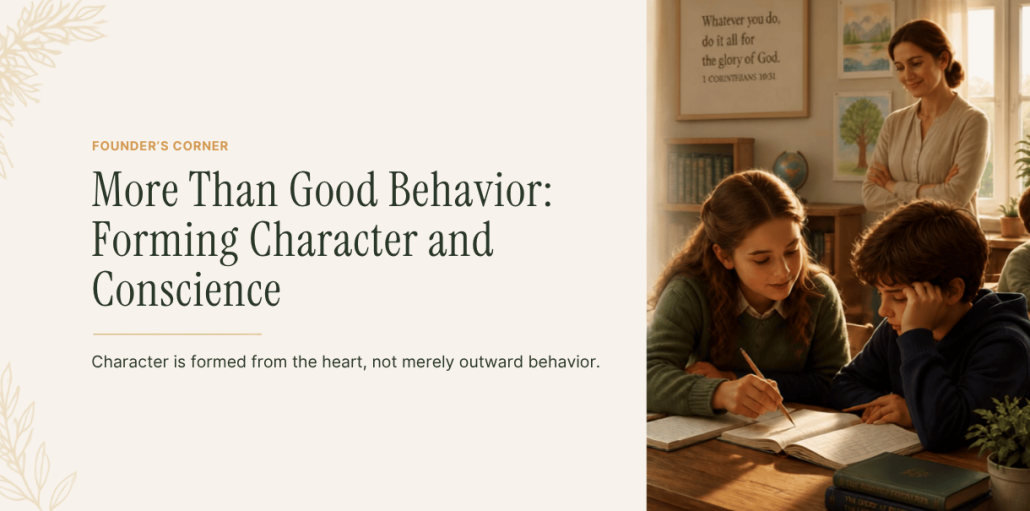
More Than Good Behavior: Forming Character and Conscience
There is a kind of obedience that lasts only as long as an adult is watching.
A child follows the instruction because a parent is nearby, completes the assignment because the teacher will collect it, or avoids a particular choice because the consequence is immediate. From the outside, the behavior may appear exactly as it should. The child has complied, the disruption has ended, and order has been restored.
Yet outward compliance does not always reveal inward conviction. A child may know what is expected without understanding why it matters. They may follow a rule in a structured environment without possessing the wisdom to make a faithful decision when the circumstances change.
This is one of the central challenges of education and discipleship. We are not simply preparing children to function well while they remain under our supervision. We are preparing them to live faithfully when the answers are less obvious, the influences are stronger, and no trusted adult is standing beside them.
Good behavior has value. Homes and classrooms need order, boundaries, respect, and responsibility. But good behavior is not the same as good character.
At Artios, our goal is not merely to produce students who know how to comply with expectations. We desire to partner with parents in forming young people whose choices increasingly flow from wisdom, conviction, and a conscience shaped by the truth of God’s Word.
Character Is Formed from the Inside Out
Character is often described as a collection of desirable qualities: honesty, responsibility, perseverance, humility, courage, gratitude, and self-control. These qualities matter, but character is deeper than a list of virtues to practice.
Character is the inward pattern from which a person lives. It becomes visible through repeated choices, particularly when those choices are difficult, costly, or unseen. Actions reveal character, but character is rooted in what a person believes, loves, values, and understands to be true.
This is why Scripture consistently directs our attention to the heart. The heart is not a sentimental or secondary part of the person. It is the wellspring from which desires, motives, thoughts, words, and actions flow. If we want to understand what a child is becoming, we must look beyond visible behavior and consider what is being cultivated within.
A child may tell the truth because lying will result in punishment, or because they are beginning to understand that God is true and that honesty reflects His character. A student may complete an assignment because they fear a poor grade, or because they are growing in responsibility and learning to steward their work faithfully. A child may treat someone kindly because an adult requires it, or because compassion is becoming part of who they are.
The outward action may look the same, but the formation taking place is very different.
This does not mean children must fully understand every principle before they are expected to obey. Children need clear instruction and boundaries long before they possess mature reasoning. Often, faithful action comes first, and deeper understanding develops over time.
Yet if education focuses only on behavior, we risk producing students who know how to meet expectations without learning how to govern themselves beneath the authority of God.
The deeper goal is Christian self-government: the growing ability to recognize what is true, choose what is right, and accept responsibility for one’s actions.
Rules Must Lead Children Toward Principles
Rules are necessary. They establish boundaries, protect relationships, and bring clarity to shared life. A child needs to know that honesty is expected, commitments matter, disrespect harms others, and work should be completed responsibly.
But rules alone cannot prepare children for every decision they will face.
No parent, teacher, handbook, or school policy can anticipate every circumstance. As children mature, they will encounter choices that do not fit neatly beneath a familiar instruction. They will hear persuasive ideas, experience competing desires, and face moments when doing what is right may cost them approval, comfort, opportunity, or belonging.
In those moments, children need more than a rule. They need principles that help them reason.
A biblical principle connects a particular expectation to an enduring truth. We tell the truth not merely because lying is prohibited, but because God is true and calls His people to reflect His character. We treat others with dignity because they bear His image. We keep our commitments because faithfulness matters. We pursue excellence because our work is an act of stewardship. We practice self-control because freedom is not the absence of restraint, but the ability to govern our desires in obedience to what is good.
When children understand that God’s commands flow from His character, obedience begins to make greater sense. Expectations are no longer merely restrictions imposed by adults. They become part of learning how to live faithfully within the world God has made.
This is how conscience is formed.
Conscience is not simply a feeling that tells us what seems right. It must be instructed, shaped, and continually brought beneath the authority of Scripture. A conscience can be weak, misinformed, dulled, or distorted. Sincerity alone does not make a conviction true.
Children therefore need help learning to examine their desires and feelings in light of God’s Word. They must learn to ask not only, “What do I want?” or “What feels right to me?” but also, “What has God said? What principle applies here? Whom will this choice affect? What kind of fruit is it likely to produce?”
These questions prepare children to reason biblically rather than simply react emotionally.
Discipline Is Part of Discipleship
When many people hear the word discipline, they think first of consequences. Consequences have an appropriate place, but biblically understood, discipline is much larger. It is training, correction, guidance, and formation directed toward maturity.
Discipline is part of discipleship.
If the primary goal of discipline is control, success is measured by whether the unwanted behavior stops. If the goal is formation, we must also consider whether the child is learning to recognize responsibility, understand the effect of their choices, and respond with honesty and humility.
There are moments when a parent or teacher must give a clear direction and expect immediate obedience. Authority should be calm and clear, and children should not be permitted to use endless discussion as a way to avoid responsibility. Yet whenever possible, correction should move beyond simple compliance.
A child may need help identifying what happened, what they were seeking, and how their choice affected another person. They may need to acknowledge responsibility without shifting blame. They may need to apologize, repair what was damaged, redo careless work, or accept an appropriate consequence.
These experiences teach that choices matter. They also teach that grace does not remove accountability.
Grace allows us to face the truth without believing that failure is the end of the story. It gives children room to repent, make amends, receive forgiveness, and grow.
Correction rooted primarily in embarrassment, anger, or fear may secure temporary obedience, but it often produces hiding rather than honesty. Children learn to avoid consequences, protect appearances, or tell adults what they want to hear. The behavior may become less visible while the heart remains unchanged.
Biblical discipline seeks something better. It tells the truth about wrongdoing while preserving the dignity of the person. It refuses to minimize sin, irresponsibility, or harm, but it also refuses to define a child by the worst thing they have done.
The goal is restoration and maturity, not humiliation.
Accountability Is Part of Growth
In our desire to protect children, it can be tempting to shield them from the results of poor choices. Parents and teachers may rescue forgotten work, excuse weak preparation, soften every disappointment, or intervene before a child experiences the weight of responsibility.
Compassion is necessary, and circumstances matter. Children require support appropriate to their age, maturity, and individual needs. There are times when mercy means reducing a burden or responding differently than we ordinarily would.
But consistently removing accountability can prevent the growth we hope to encourage.
A student who does not prepare for a presentation may need to experience the discomfort of being unprepared. A child who damages trust may need to understand that rebuilding it takes time. A group member who neglects a responsibility may need to repair the effect on others. A student who produces careless work may need to revise it rather than receive praise simply for finishing.
These moments are not interruptions to education. They are part of education.
Responsibility develops when children are allowed to carry responsibility. Integrity grows when truthfulness is required even when honesty is costly. Perseverance grows when difficulty cannot always be avoided. Humility grows when correction must be received rather than explained away.
Accountability also teaches students that choices are never entirely private. Every family and classroom is a community. Poor preparation places pressure on others. Disrespect changes the atmosphere of a room. Dishonesty damages trust. Faithfulness, kindness, and responsibility strengthen the people around us.
Character is personal, but it is never merely individual.
Character Is Woven Through Learning
Character formation does not happen only in moments of correction. It is woven into the ordinary content of education.
History, biography, literature, and the arts give students opportunities to examine the beliefs and choices of people across time. They help children see that ideas have consequences and that inward convictions eventually become visible through action.
When students study a historical figure, they can move beyond remembering accomplishments and dates to consider what beliefs guided that person, how power was used, how adversity was handled, and what fruit followed particular choices. Courage, ambition, pride, sacrifice, deceit, perseverance, mercy, and injustice become more than abstract ideas when students encounter them in real lives.
Literature offers similar opportunities. Stories allow students to enter the moral imagination of another person. They encounter characters who desire, fear, fail, endure, betray, repent, sacrifice, and hope. A thoughtful teacher can help students move beyond whether they liked a character and ask deeper questions: What did this person love? What governed their decisions? What lie did they believe? What truth did they refuse to see? What did their choices cost?
The arts likewise express something about beauty, suffering, identity, freedom, love, and meaning. Students can appreciate craftsmanship while also discerning the worldview and character being communicated.
Character and conscience are not separate subjects added to the end of a lesson. They are part of understanding people, ideas, cultures, and the consequences that unfold throughout God’s story.
Facts tell us what happened. Character helps us understand why people acted as they did and what followed from their choices.
Adults Must Embody What They Teach
Children learn character not only through instruction, but through observation. They watch how parents and teachers respond when plans change, when work becomes frustrating, when correction is deserved, and when another person is difficult to love.
We cannot guide children toward humility while refusing to admit our own mistakes. We cannot teach self-control through uncontrolled anger or expect honesty while protecting our own image. We cannot cultivate responsibility if we treat our commitments casually.
This does not mean adults must model perfection. In fact, children may learn some of the clearest lessons about character when an adult acknowledges wrongdoing, asks forgiveness, and makes a faithful correction.
Repentance is not a failure of leadership. It is part of Christian leadership.
Parents and teachers are being formed alongside the children entrusted to them. Guiding a young person often exposes our own impatience, fear, pride, or desire for control. God uses these relationships not only to shape the child, but also to refine the adults who are doing the shaping.
Our authority does not rest on the claim that we have completed the work of formation. It rests on our willingness to remain beneath the authority of God’s Word and to point children toward Christ.
Preparing Children for the Choices We Cannot Make for Them
There comes a time in every child’s life when parents and teachers are no longer present to supervise the decision.
The familiar structure changes. New voices become influential, new pressures emerge, and choices carry greater consequences. At that point, the question will not simply be whether the young person remembers the rules.
The question will be whether truth has taken root deeply enough to guide them.
Have they learned to recognize God’s character as the foundation for what is good? Can they reason from biblical principles when circumstances are complicated? Are they able to govern their desires rather than be governed by them? Can they accept responsibility, receive correction, and make amends when they fail? Do they possess the courage to do what is right even when it is unpopular or costly?
These qualities cannot be manufactured at the moment they are needed. They are cultivated slowly through instruction, example, accountability, relationship, failure, repentance, and repeated opportunities to choose faithfully.
Academic knowledge matters. Artistic skill matters. Preparation for future study and work matters. But if a student is highly capable and lacks integrity, discernment, courage, and self-government, that education has not fully prepared the person.
At Artios, we desire something deeper than well-behaved students who know how to succeed within a structured environment. We want to partner with parents in raising young people who understand why truth matters, whose consciences are being shaped by Scripture, and whose character increasingly reflects Christ.
They will not do this perfectly. Neither will we.
But through the patient work of discipleship, children can grow from merely following expectations toward understanding and embracing what is true. They can learn that obedience is not an empty demand, accountability is not rejection, and discipline is not merely punishment. Each can become part of God’s gracious work of forming them into wise, responsible, and faithful people.
That is the goal: not behavior maintained by the presence of an authority, but character that remains when no one else is watching.
Faith and Courage,
Lori Lane
Founder, Artios Academies


