
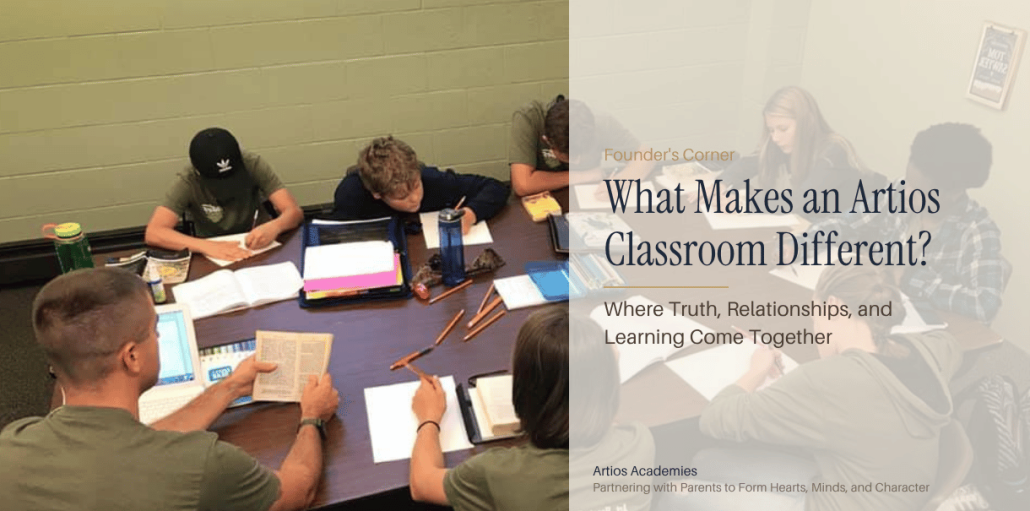
What Makes an Artios Classroom Different?
When parents consider an educational program, they naturally begin with practical questions. They want to know what curriculum will be used, which classes will be offered, how assignments will be structured, and whether the program will prepare their child academically. These questions matter, but beneath them is often a deeper concern that is more difficult to measure.
What will my child experience in this classroom each day?
Parents want to know whether their child will be seen and understood. They wonder whether the teacher will recognize both strengths and struggles, whether their child will be challenged without being discouraged, and whether the classroom will reinforce the truths and values being cultivated at home. They are not simply evaluating a program. They are considering an environment that will participate in the formation of their child.
This is why a classroom can never be understood only by examining its curriculum, schedule, or academic outcomes. A classroom has a culture, and that culture is always teaching. Students are shaped by what is consistently emphasized, modeled, encouraged, corrected, and celebrated. They learn from the way authority is exercised, the way mistakes are handled, the way people speak to one another, and the way truth is connected to life.
At Artios, what makes a classroom different is not a particular technique or uniform teaching style. It is a shared understanding of who the child is, what education is for, and how God’s Word should shape the ordinary work of teaching and learning.
The Classroom Begins with How We See the Child
Every educational environment operates from some view of the child, whether that view is clearly stated or simply assumed.
A child may be viewed primarily as a student who must meet academic standards, a performer who must produce measurable results, or a behavior problem that must be managed. Even well-intentioned educational systems can begin to treat children according to their usefulness, achievement, or ability to fit within an established structure.
Scripture gives us a different starting point.
A child is a whole person created in the image of God. Each student possesses God-given dignity and has been entrusted with particular strengths, weaknesses, gifts, responsibilities, and needs. Children are not defined by performance, but neither are they left without direction. They are image-bearers who require instruction, correction, grace, discipleship, and growth.
Holding these truths together changes the way a teacher approaches the classroom.
A struggling student is not simply slowing down the lesson. A gifted student is not more valuable because achievement comes easily. A quiet child should not disappear behind louder personalities, and a child who learns differently should not be treated as an inconvenience. Each student is a person to be known and faithfully guided.
This does not mean that every preference can be accommodated or that expectations become individualized beyond recognition. A healthy classroom still requires shared standards, responsibility, and order. Biblical individuality is not the freedom to avoid what is difficult or do only what feels natural. It is the recognition that God forms different people in different ways and calls each one to faithful stewardship.
An Artios teacher therefore aims to teach the students who are actually present. The teacher may challenge one student to persevere, invite another to participate more courageously, and help another slow down and work with greater care. The goal is not to make every student the same, but to help each one grow in wisdom, responsibility, and faithful use of what God has given.
The Heart Is Part of Every Lesson
Because Scripture describes the heart as the wellspring of life, education cannot be concerned only with outward behavior or academic completion. Students do not enter a classroom as minds disconnected from their desires, fears, motivations, and relationships. The whole person is present in every lesson.
This becomes especially important when correction is needed.
Two students may display the same behavior for very different reasons. One may resist an assignment because of pride, while another withdraws because of fear. One student may speak carelessly out of frustration, while another seeks attention or approval. If a teacher addresses only the visible action, the immediate behavior may change without producing deeper understanding or conviction.
An Artios classroom must certainly have clear expectations and appropriate consequences. Order matters because people matter, and students must learn that their choices affect the entire community. Yet correction should aim at more than control. It should help students recognize responsibility, consider what their choices reveal, and understand how truth applies to their actions.
This may involve questions such as: What happened? What were you wanting in that moment? How did your choice affect someone else? What responsibility belongs to you now? What would it look like to make this right?
Questions like these help move a child from avoiding consequences toward developing conscience. The student begins to understand that obedience is not simply about staying out of trouble, but about learning to love what is good, take ownership of choices, and live faithfully toward God and others.
This kind of formation does not happen quickly. It requires consistency, patience, repeated truth, and opportunities to begin again. It also requires adults who remember that shame does not produce the kind of heart transformation we desire. Students need truth, but truth should be spoken in a way that preserves the dignity of the person and leaves room for repentance, restoration, and growth.
Scripture Shapes More Than Bible Class
A Christian classroom is not made distinctly Christian simply because it begins with prayer, uses Christian materials, or places Bible verses within the lesson. These practices may be meaningful, but biblical education requires something deeper.
God’s Word must shape how the classroom understands truth, people, authority, knowledge, work, beauty, failure, relationships, and responsibility.
This means that Scripture is not treated as an addition to the educational process. It is the foundation from which teachers and students learn to see the world. History, literature, science, music, theatre, and visual art are not spiritually neutral subjects that become Christian only when a verse is added. Each one raises questions about God, humanity, creation, truth, beauty, sin, culture, and redemption.
History reveals the beliefs and choices that shape people and nations. Literature gives students opportunities to examine human nature, desire, sacrifice, courage, brokenness, and hope. Science invites them to study a world marked by order, complexity, and beauty while considering humanity’s responsibility to steward creation wisely. The arts communicate the longings, ideas, assumptions, and values of individuals and cultures.
Biblical integration helps students ask better questions. What does this idea assume to be true? What does this work reveal about the human heart? Where does it align with Scripture, and where does it stand opposed to truth? What fruit has this belief produced? How should a Christian respond?
These questions do not require simplistic answers. In fact, students need teachers who are willing to engage complexity without surrendering biblical authority. The goal is not to force a spiritual statement into every discussion, but to teach students that Christ is Lord of every subject and that all knowledge must ultimately be understood within God’s larger story.
Learning Happens in Relationship
Education is sometimes described as though information moves in a straight line from curriculum to teacher to student. In reality, learning is far more relational.
Students learn through their relationship with the teacher, with one another, with the material, and with the questions that arise as they encounter new ideas. They are not only receiving facts. They are forming habits of attention, interpretation, communication, and discernment.
This is why thoughtful discussion matters in an Artios classroom. Students need opportunities to explain what they think, listen to another perspective, support their conclusions, ask questions, and revise their understanding. These practices help them move beyond seeking the answer the teacher wants and toward a deeper engagement with truth.
The teacher still carries responsibility for leadership and direction. Truth is not determined by the strongest opinion in the room. Yet students should be invited to participate actively in learning rather than remaining passive recipients of information.
As they discuss literature, examine historical choices, respond to artwork, collaborate on a performance, or work through a difficult concept, they are learning how to reason, relate, discern, discuss, and express. These abilities prepare them for far more than academic success. They are necessary for faithful participation in family, church, work, community, and culture.
Relationships among students are also part of this formation. A classroom gathers people with different abilities, personalities, experiences, and levels of maturity. That difference creates opportunities for friendship and collaboration, but it can also expose impatience, comparison, selfishness, and pride.
For this reason, community cannot be treated as a pleasant byproduct of the classroom. Students must be taught how to listen, contribute, disagree respectfully, receive feedback, share responsibility, apologize, forgive, and serve the good of the group. A conflict is not merely an interruption to learning. Handled wisely, it can become a lesson in truth, humility, courage, boundaries, and reconciliation.
Excellence and Grace Belong Together
Whole-hearted education is not careless education. An Artios classroom should call students toward preparation, diligence, craftsmanship, responsibility, and growth.
Students need honest feedback. They need to practice what is difficult, revise work that is incomplete, and persevere when mastery does not come quickly. Grace does not mean that poor preparation is ignored or that every effort receives the same evaluation.
At the same time, excellence must not be confused with perfectionism.
Perfectionism teaches students that mistakes threaten their identity and that worth is tied to achievement, comparison, or flawless performance. Excellence calls them to faithful stewardship. It asks whether they have prepared carefully, responded humbly to instruction, persevered through difficulty, and offered their best with the gifts and maturity God has presently given them.
This distinction changes the atmosphere of a classroom.
A student can receive correction without being shamed. A musician can repeat a difficult passage without believing that struggle is failure. A writer can revise a paper and understand that revision is part of learning. An actor can receive direction and grow in humility, collaboration, and attentiveness.
In each case, the academic or artistic task becomes part of a larger process of formation. The student is not simply learning a skill. The student is developing perseverance, responsibility, teachability, and courage.
High standards and grace do not oppose one another. When rightly understood, they work together. Grace gives students room to grow, while excellence calls them to steward that opportunity faithfully.
A Classroom in Partnership with the Family
An Artios classroom does not exist independently from the family. Parents remain the primary disciplers of their children, and the classroom is meant to strengthen rather than replace that calling.
Teachers may see aspects of a child that become visible in a group setting. They may notice leadership, compassion, avoidance, creativity, discouragement, or perseverance in ways that are different from what parents observe at home. Parents, in turn, know the child’s history, needs, patterns, and circumstances in ways a teacher cannot.
When parents and teachers communicate with humility and shared purpose, the child is more fully known. The home can continue conversations that begin in class, while the classroom can reinforce truths being cultivated within the family.
This partnership does not mean that parents and teachers will always interpret every situation in the same way. Healthy partnership requires listening, honesty, and sometimes difficult conversations. Yet when both are moving toward the same biblical end, the child experiences greater coherence.
Faith is no longer presented as something belonging only to home, church, or Bible class. The student sees that love for God and obedience to His Word shape study, creativity, relationships, correction, responsibility, and work.
What Difference Should We See?
No classroom will embody these convictions perfectly. Teachers are still growing, students are still maturing, and some days will reflect the vision more clearly than others. Lessons will not always unfold as planned, communication will sometimes fall short, and opportunities will occasionally be missed.
The purpose of a philosophy is not to create the appearance of perfection. It is to provide a plumb line that helps us recognize drift, make wise adjustments, and return to what matters.
An Artios classroom should therefore not be measured by whether every teacher has the same personality or every room operates in precisely the same way. Different teachers bring different gifts, experiences, and strengths. One may lead through storytelling and warmth, another through scholarship and thoughtful questions, and another through careful craftsmanship and organization.
What should remain consistent is the deeper direction of the classroom.
Students should experience that truth matters, that they possess God-given dignity, and that their hearts cannot be separated from their learning. They should be challenged to think carefully, work faithfully, treat others with love, and receive correction with humility. They should be invited to recognize beauty, steward their gifts, and see every subject as part of God’s world.
This is what makes an Artios classroom different.
It is not merely a room where Christian students receive information or where academic and artistic subjects are taught creatively. It is a community of formation in which teachers come alongside families to help children grow in wisdom, character, skill, responsibility, and love for Christ.
When these convictions are lived faithfully, the classroom becomes more than a place where lessons are completed. It becomes a place where knowledge is joined to wisdom, excellence is joined to grace, and learning is joined to life.
Faith and Courage,
Lori Lane
Founder, Artios Academies


