
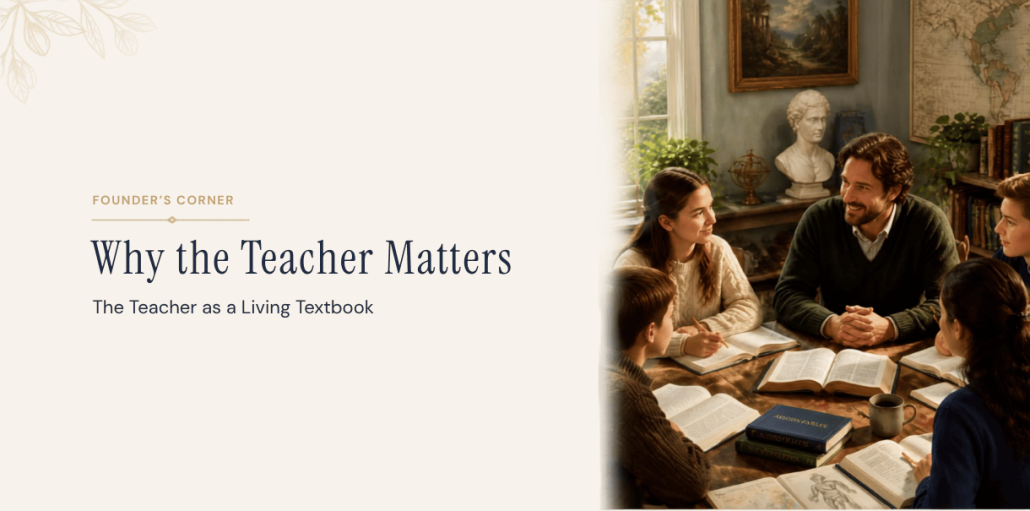
Why the Teacher Matters: The Teacher as a Living Textbook
Most of us can remember at least one teacher who changed the way we saw something.
Perhaps it was a teacher whose love of history made the past feel alive, whose delight in literature helped us recognize ourselves within a story, or whose patience gave us the courage to keep working when a subject did not come easily. Perhaps it was a music teacher who taught us to listen more carefully, an art teacher who helped us notice what we had previously overlooked, or a theatre teacher who called forth courage we did not know we possessed.
Years later, we may no longer remember every assignment, lecture, or page we completed. We may forget the details of the curriculum or the sequence of the lessons. But we remember the person.
We remember how they made us feel about learning.
We remember whether they saw us.
We remember whether their classroom was marked by curiosity or boredom, patience or frustration, humility or pride, joy or weariness. We remember whether they treated their subject as something alive and meaningful or simply as material that had to be covered.
That memory reveals something important about education: learning is never shaped by content alone.
It is shaped by people.
At Artios, we have long used the phrase “living textbook” to describe the role of the teacher. The phrase may sound unusual at first, particularly in an educational culture that often places its greatest confidence in programs, methods, technology, and carefully constructed curriculum. Those things can be valuable. Good curriculum matters. Thoughtful methods matter. Preparation, organization, and academic skill matter.
But none of them can replace the formative influence of a living person.
Education is not simply delivered. It is embodied.
The Teacher Is Always Teaching
A teacher teaches far more than the lesson written in the plan.
Students are constantly observing how the adults around them respond to difficulty, interruption, disagreement, failure, beauty, responsibility, and truth. They are learning whether questions are welcomed, whether mistakes are survivable, whether preparation matters, whether people are worthy of patience, and whether the pursuit of wisdom is genuinely joyful.
A teacher may be explaining a mathematical concept, leading a literature discussion, directing a rehearsal, or demonstrating an artistic technique. But at the same time, that teacher is communicating something about the nature of work, the value of the student, the meaning of excellence, and the posture we should take toward learning.
This is not an additional part of education. It is part of the lesson itself.
A teacher who responds harshly to every interruption may teach a perfectly accurate lesson while also communicating that efficiency matters more than people. A teacher who is unwilling to admit an error may communicate that authority requires the appearance of perfection. A teacher who rushes through beautiful material without wonder may unintentionally teach students that learning is primarily about completion.
In the same way, a teacher who prepares carefully communicates that the work is worthy of attention. A teacher who listens well communicates that the student is worthy of being known. A teacher who receives correction humbly demonstrates that learning is a lifelong calling. A teacher who delights in truth and beauty invites students to delight in them as well.
Children are always learning—not only from what adults tell them, but from what adults consistently live.
This is why the person of the teacher matters so deeply.
Christ, the Perfect Living Textbook
Scripture gives us the fullest picture of a living teacher in the person of Jesus Christ.
Christ did not merely speak truth. He embodied it.
John tells us that the Word became flesh and dwelt among us. Truth was not presented only as an idea to be considered or a principle to be memorized. Truth came near. The disciples saw the character of God expressed through the life of Christ—in His compassion, courage, patience, holiness, justice, mercy, obedience, and love.
Jesus taught through sermons, parables, questions, conversations, and Scripture. But He also taught while walking along roads, sharing meals, responding to interruptions, confronting hypocrisy, welcoming children, restoring sinners, serving His disciples, and enduring suffering faithfully.
His life was not separate from His message.
He was the perfect picture of what He taught.
This does not mean that teachers must attempt to take the place of Christ in the lives of students. It means that Christian teachers are called to point toward Him not only through the truth they communicate, but through the manner in which they live.
The apostle Paul expressed this kind of discipleship when he invited others to follow his example as he followed Christ. That invitation carries humility and responsibility. Paul did not claim perfection. He understood that his life was being observed, and he wanted what others saw in him to direct them toward the One he followed.
In much the same way, Christian teaching is not simply the presentation of Christian ideas. It is the faithful embodiment of a Christian way of seeing and living.
Teachers are not merely explaining truth.
They are showing students what it looks like to live beneath its authority.
Expertise Matters, but It Is Not Enough
To say that the teacher is a living textbook does not minimize the importance of academic competence. In fact, it raises the standard.
A living-textbook teacher should know the subject, prepare thoughtfully, communicate clearly, and continue growing in skill. Love for students is not a substitute for careful instruction. Sincerity does not excuse a lack of preparation. A teacher who wants to inspire students must first be willing to study, practice, refine, and remain teachable.
At the same time, expertise alone is not enough.
A teacher may possess significant knowledge and still be unable to awaken a student’s interest. A teacher may master the material and yet fail to see the child sitting in front of them. A teacher may communicate information accurately while presenting learning as cold, lifeless, or disconnected from God and His world.
Knowledge becomes life-giving when it is carried by a person who recognizes that the subject matters, the student matters, and the relationship between them matters.
A living teacher brings more than information into the classroom. The teacher brings curiosity, experience, conviction, attentiveness, personality, and love. The teacher notices when students are confused, when they are ready to be challenged, when they need encouragement, and when a question has opened the door to something deeper than the original lesson plan.
This kind of teaching cannot be reduced to a script.
It requires presence.
It requires the teacher to know the material well enough to make wise adjustments and to know the students well enough to understand what those adjustments should be.
That is part of what makes education relational. A child is not a generic recipient of information. A child is a whole person, created in the image of God, with particular strengths, struggles, questions, gifts, fears, and responsibilities.
The living teacher does not merely ask, “Did I cover the material?”
The teacher also asks, “Did the student encounter truth? Did the lesson awaken thought? Was the child invited to reason, relate, discern, discuss, and express? What is this learning forming in the heart?”
Bringing Curriculum to Life
Curriculum plays an important role in education. It provides structure, sequence, content, and direction. A strong curriculum reflects a coherent philosophy and helps teachers and students move through learning with clarity and purpose.
But curriculum was never meant to replace the teacher.
A textbook cannot notice the expression on a student’s face. A lesson plan cannot pause because a thoughtful question has opened an unexpected opportunity. A set of instructions cannot recognize when a child needs greater challenge, a different explanation, or the reassurance that struggle does not mean failure.
Curriculum can organize learning, but a teacher brings it into relationship with the real students in the room.
This is especially important within a whole-hearted educational model. If education is concerned only with completing material, then it may be possible to imagine curriculum functioning almost independently. But if education is concerned with wisdom, character, conscience, imagination, relationship, and calling, then the presence of a thoughtful adult becomes indispensable.
A living teacher helps students see why the material matters.
History becomes more than dates when a teacher helps students examine the beliefs, choices, character, and consequences that shaped people and cultures. Literature becomes more than plot when a teacher helps students consider what a story reveals about human nature, truth, sin, redemption, courage, or sacrifice. The arts become more than technical exercises when a teacher helps students recognize beauty as a gift and creativity as a form of stewardship.
The material may be present in the curriculum, but the teacher helps students enter into it.
The teacher breathes life into learning.
What Students Read in Their Teachers
When we call teachers living textbooks, we are acknowledging that students are continually “reading” the adults who teach them.
They are reading the teacher’s attitude toward the subject. Does the teacher still find it worthy of attention? Is there delight, wonder, and curiosity, or has familiarity produced indifference?
They are reading the teacher’s attitude toward work. Does the teacher prepare carefully? Follow through faithfully? Admit when something could have been done better? Demonstrate that excellence is not perfection, but responsible stewardship?
They are reading the teacher’s attitude toward people. Are students treated with dignity even when correction is necessary? Is individuality recognized without removing accountability? Are stronger students favored, or is each child understood as an image-bearer worthy of care?
They are reading the teacher’s attitude toward authority. Is Scripture truly the foundation, or merely something added to an otherwise unchanged lesson? Does the teacher approach God’s Word with reverence and humility? Is truth treated as something to be obeyed as well as understood?
They are reading the teacher’s response to weakness. Does difficulty produce shame, impatience, or fear? Or does it become an opportunity for perseverance, compassion, repentance, and growth?
None of this requires a flawless teacher.
In fact, students may learn some of the most important lessons when a teacher acknowledges a mistake, asks forgiveness, receives feedback, or demonstrates how a Christian responds when things do not go as planned.
A living textbook is not a perfect textbook.
A living textbook is a faithful person who is continuing to be formed by Christ.
Teachers as Fellow Learners
One of the most important qualities of a life-giving teacher is a willingness to remain a learner.
The best teachers do not stand before students as people who have arrived at the end of knowledge. They model curiosity. They continue reading, asking questions, refining their craft, and deepening their understanding of Scripture, their subject, and the students entrusted to them.
This posture matters because humility creates room for growth.
When teachers approach learning with wonder, students begin to see that education is not something adults complete and then leave behind. Learning is part of faithful stewardship throughout life. We continue to discover more of the order, beauty, complexity, and meaning God has woven into His world.
A teacher who remains teachable also creates a different kind of classroom. Questions do not threaten authority. A student’s insight can be received with gratitude. Correction does not become humiliation. The pursuit of truth is shared, even while the teacher maintains appropriate responsibility and leadership.
This does not erase the distinction between teacher and student. It strengthens it.
A teacher leads most faithfully when that leadership is marked by confidence without pride, authority without harshness, and humility without uncertainty about truth.
Partnership, Not Replacement
Because teachers possess such significant influence, it is important to place that influence within its proper biblical context.
The teacher does not replace the parent.
Parents remain the primary disciplers of their children. They are the adults entrusted with the daily, lifelong work of formation. Artios comes alongside that calling by providing teachers, instruction, relationships, community, and opportunities that strengthen what God has entrusted to the family.
This partnership becomes especially powerful when home and classroom are moving in the same direction.
When parents and teachers share a commitment to biblical truth, children experience greater coherence. They hear similar language about responsibility, wisdom, excellence, repentance, service, and stewardship. They see multiple adults living under the authority of God’s Word. They learn that faith is not confined to home, church, Bible class, or a devotional moment. It shapes the way people study, create, lead, correct, collaborate, and respond to difficulty.
Parents are living textbooks too.
Children learn from what we love, what we fear, what we prioritize, how we speak, how we handle frustration, and whether we remain willing to grow. This truth is weighty, but it should not lead us toward perfectionism. It should lead us toward dependence upon Christ.
Neither parents nor teachers can form a child through their own strength.
Our calling is to be faithful, attentive, prayerful, and willing to be formed even as we participate in the formation of others.
The Teacher Matters Because the Child Matters
At the center of this conversation is not the status of the teacher or the effectiveness of a particular technique.
It is the child.
The teacher matters because the child is a person, not a product. The child is not merely completing material, earning grades, developing talent, or preparing for future employment. The child is learning how to see God, self, others, work, truth, beauty, responsibility, and the world.
That kind of learning requires more than information.
It requires adults who are willing to walk alongside children—to teach carefully, model honestly, correct graciously, prepare faithfully, and continually point beyond themselves to Christ.
A curriculum may help determine what a student studies during a particular year.
A living teacher may help shape how that student approaches learning for the rest of life.
A Final Thought
Long after students forget a particular assignment, they may remember the teacher who made them feel that truth was worth pursuing.
They may remember the adult who noticed their gift before they recognized it themselves. They may remember being challenged to work harder without being made to feel that their worth depended upon performance. They may remember a teacher who treated Scripture as living and authoritative, who responded to mistakes with humility, and who demonstrated that excellence and grace belong together.
They may remember what it looked like to love God with the mind, to steward a gift faithfully, to remain curious, and to serve others through what they were learning.
This is why the teacher matters.
Not because teachers are perfect.
Not because their influence replaces the family.
And not because curriculum, content, or academic skill are unimportant.
The teacher matters because education is relational, truth is meant to be lived, and children need more than information placed before them. They need faithful people who will help them see what truth looks like when it takes on flesh in the ordinary work of learning.
At Artios, this is what we mean by a living textbook: a teacher whose preparation, curiosity, humility, character, and love breathe life into the material—and whose life, however imperfectly, continues to point students toward Christ.
Faith and Courage,
Lori Lane
Founder, Artios Academies


